Live Review
Andrea Bocelli Lets Romanza Unfold Slowly at the Hollywood Bowl
Thirty years after the album that pushed his voice around the world, Andrea Bocelli returned to Los Angeles with opera, orchestra, unexpected guests and the songs that made Romanza endure.
Los Angeles · Hollywood Bowl
Published September 18, 2026 · Event September 16, 2026
Words by Andrew Wong
Photography by Andrew Wong
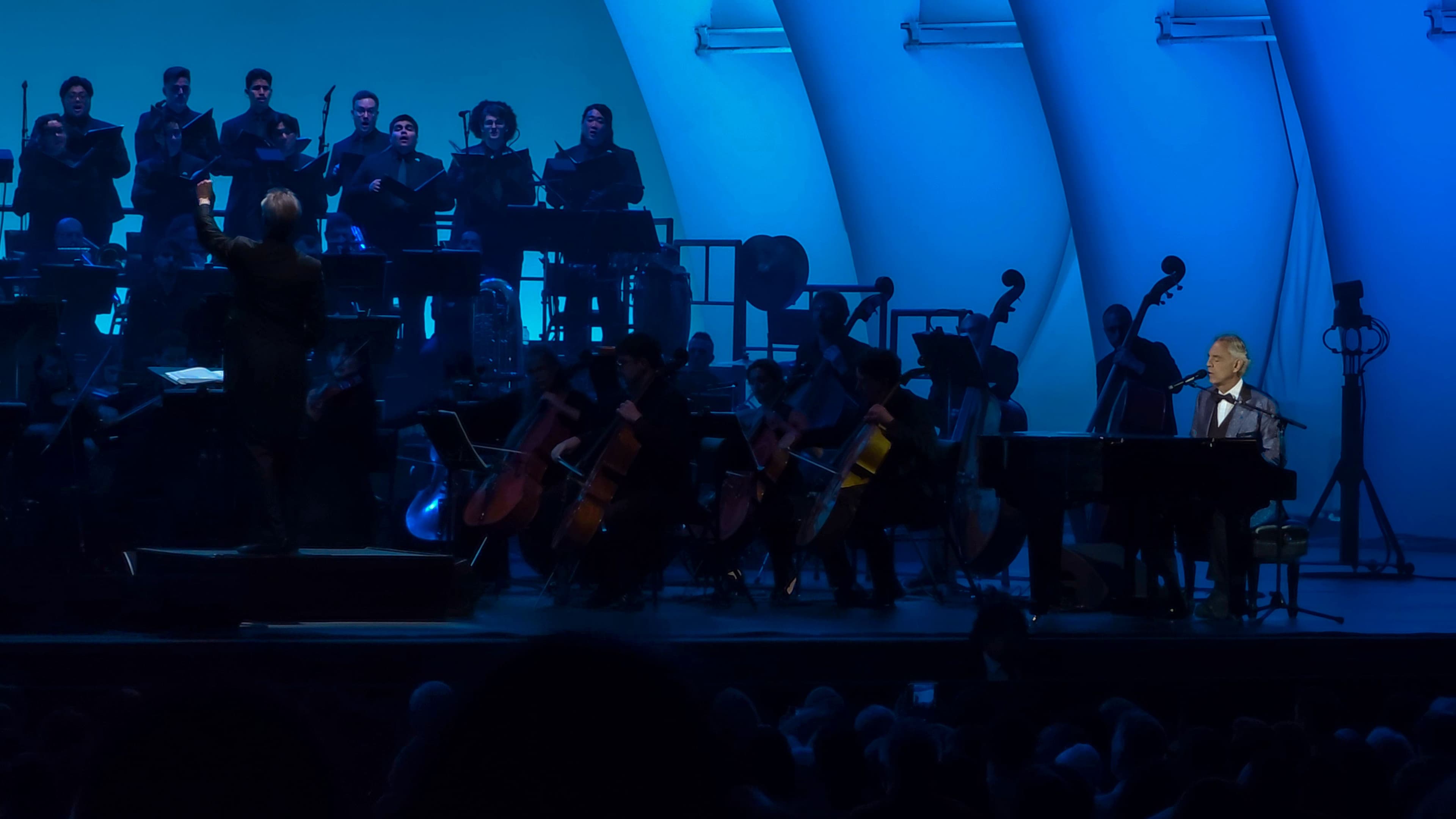
There would have been an easy way for Andrea Bocelli to celebrate 30 years of Romanza: walk onto the Hollywood Bowl stage and immediately begin playing the songs everyone came expecting to hear.
He did almost the opposite.
Bocelli’s Sept. 16 performance, the second of two nights at the Hollywood Bowl on his Romanza – 30th Anniversary World Tour, spent much of its opening stretch in the operatic world that shaped him before gradually working its way toward the crossover repertoire that made his name recognizable far beyond classical music. The result felt less like an anniversary playback of one album and more like an attempt to explain the musical path that eventually produced it.
That meant beginning with Verdi.
“Di quella pira” and “La donna è mobile” opened the program before soprano Larisa Martinez entered for Léo Delibes’ “Les filles de Cadix.” She later joined Bocelli for Puccini’s “Bimba dagli occhi pieni di malia” and the familiar “Brindisi” from La Traviata. Baritone Edward Parks took his own turn with Rossini’s “Largo al factotum,” while the choir was given one of the evening’s biggest standalone moments with “O Fortuna.”
For anyone arriving primarily for “Con te partirò,” it was a patient beginning.
But the length of that classical section also made the eventual shift more noticeable. Under conductor Steven Mercurio, the large orchestra and choir were not simply decoration behind Bocelli. They were given long stretches in which the concert functioned much more like a traditional classical program, including a West Side Story medley that moved through pieces including “I Feel Pretty,” “Maria,” “Tonight” and “America.”
That structure is important to understanding why Bocelli has remained such an unusual figure in popular music. His career has never required him to choose completely between opera and pop. Instead, he has spent decades moving between them.
Eventually, the concert arrived at Romanza.
Bocelli moved to the piano for the title track and “Il mare calmo della sera,” turning one of the evening’s largest productions into something comparatively restrained. It was an effective change in scale. After the choir, dancers and full orchestral arrangements that had filled the Bowl earlier, seeing Bocelli seated behind a piano returned attention to the melodies themselves.
The significance of those songs is difficult to separate from what happened after their original release. Romanza, released internationally in 1997, became Bocelli’s breakthrough album and went on to sell roughly 20 million copies worldwide. Its combination of classical technique and accessible romantic songs helped establish the model Bocelli has continued to work within ever since. A 30th-anniversary edition, including the original album alongside previously unreleased material, is due Sept. 25.
The later portion of the show leaned increasingly into that crossover identity.
Pia Toscano brought a distinctly pop vocal approach to “All by Myself,” while Bocelli’s own repertoire moved through “Vivere,” “Vivo per lei” and “Canto della terra.” The gradual transition meant that the songs most immediately associated with Bocelli arrived not as the entire point of the evening, but as the destination.
With that many guests, soloists, dancers, choir members and orchestral passages, Bocelli himself was occasionally absent from the center of his own concert. That could feel unusual for an audience expecting two uninterrupted hours of the tenor, but it also revealed how large the world surrounding these songs has become. This was presented less as Andrea Bocelli alone than as an evening built around the musical traditions his career has crossed.
And then, inevitably, came “Con te partirò.”
Thirty years after Romanza carried the song to audiences around the world, there is little novelty left to uncover in it. Its opening notes are recognizable almost immediately. But hearing it with a full orchestra inside the Hollywood Bowl made familiarity part of the appeal. The audience did not need to be surprised by the song. They had been waiting for it.
Bocelli closed with Puccini’s “Nessun dorma,” returning the concert to opera after spending the later stretch moving steadily toward pop.
It made for an appropriately circular ending.
The Romanza anniversary could easily have been presented entirely as nostalgia for the album that changed Bocelli’s career. Instead, the Hollywood Bowl show placed that record between the two musical worlds that have always defined him.
Thirty years later, Romanza matters not just because of how many copies it sold.
It matters because Bocelli is still building concerts around the musical bridge it created.
Contributors
Words and photography
Andrew Wong
Founder · Editor in Chief · Journalist · Photographer
Andrew Wong is the founder and editor in chief of R’Time in a Flash. A journalist and concert photographer, he covers live music across Los Angeles and Orange County through reporting, reviews, and original photography.